Absolute Beginner DevOps Learning Roadmap
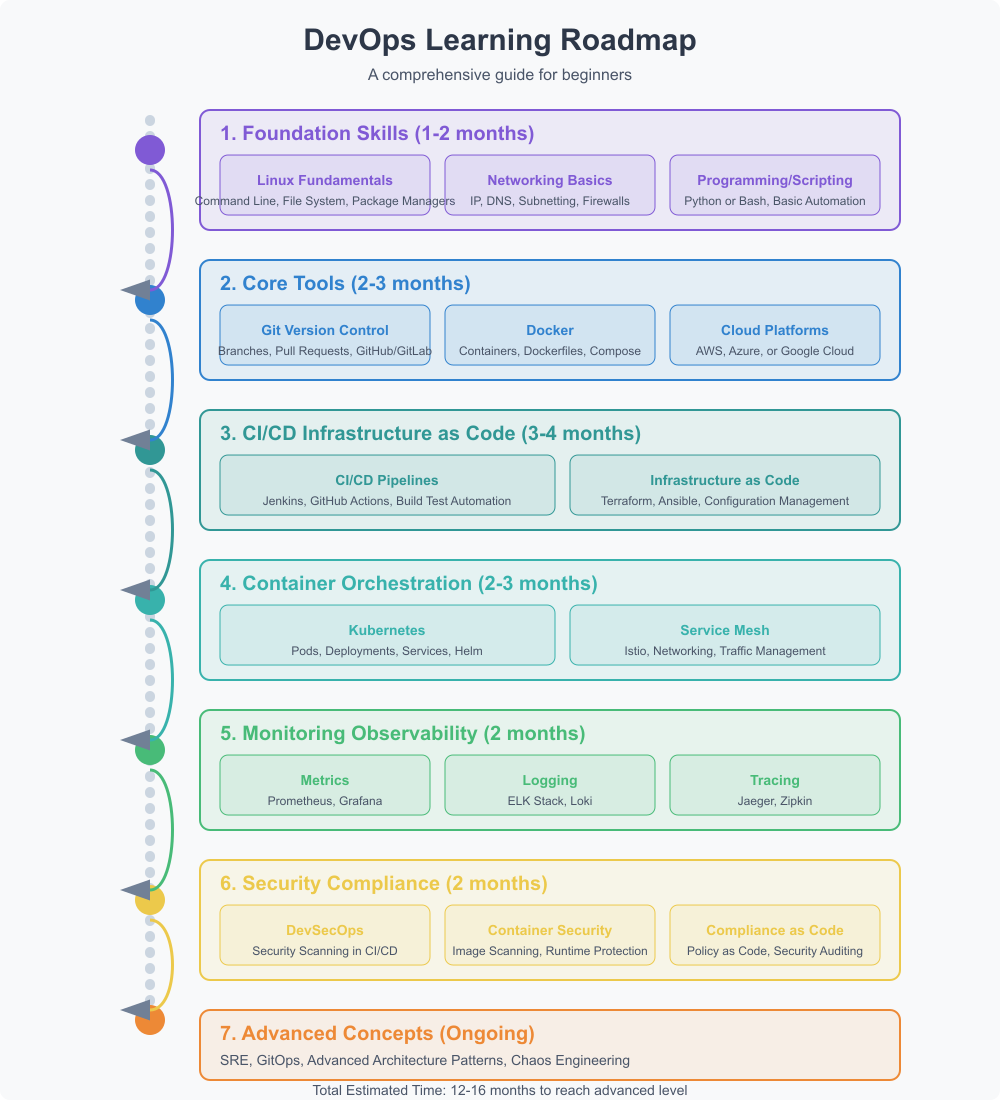
This roadmap breaks down each phase into specific learning objectives and suggests potential tools and areas of focus. Remember to prioritize hands-on practice alongside theoretical learning.

DevOps has transformed how organisations build, deploy, and maintain software. By breaking down silos between development and operations teams, DevOps practices enable faster, more reliable software delivery. If you're looking to start a career in this high-demand field but don't know where to begin, this roadmap will guide you through your learning journey.
What is DevOps?
DevOps is both a cultural philosophy and a set of practices that combines software development (Dev) and IT operations (Ops). It aims to shorten the development lifecycle while delivering features, fixes, and updates frequently and reliably.
The core principles include:
Collaboration: Breaking down barriers between development and operations
Automation: Reducing manual effort and human error
Continuous Integration/Continuous Delivery (CI/CD): Enabling frequent, reliable releases
Monitoring and Feedback: Constantly improving based on real performance data
The DevOps Learning Journey
Phase 1: Build a Strong Foundation (1-2 months)
Learn Linux Fundamentals
Basic command line operations
File system navigation
User management
Process management
Package installation
Shell scripting basics
Understand Networking Concepts
IP addressing and subnets
DNS, HTTP/HTTPS protocols
Firewalls and security basics
Load balancing concepts
Learn Version Control with Git
Basic commands (clone, add, commit, push, pull)
Branching and merging strategies
Pull requests and code reviews
Using GitHub/GitLab/Bitbucket
Programming/Scripting Language
Learn at least one scripting language:
Python (recommended for beginners)
Bash scripting
PowerShell (for Windows environments)
Phase 2: Infrastructure as Code & Containerization (2-3 months)
Learn Containerization with Docker
Container concepts
Creating Dockerfiles
Managing images and containers
Docker networking and volumes
Docker Compose for multi-container applications
Container Orchestration with Kubernetes
Kubernetes architecture
Pods, deployments, services
ConfigMaps and secrets
Basic cluster management
Helm charts for package management
Infrastructure as Code
Terraform basics
Writing infrastructure as code
Managing state
Creating reusable modules
Provisioning cloud resources
Configuration Management
Ansible basics
Writing playbooks
Inventory management
Roles and variables
Idempotent configuration
Phase 3: CI/CD & Cloud Platforms (2-3 months)
Continuous Integration/Continuous Delivery
CI/CD concepts and practices
Setting up CI/CD pipelines with:
Jenkins
GitHub Actions
GitLab CI
CircleCI
Cloud Platforms (focus on one initially)
AWS:
EC2, S3, RDS
VPC, IAM, Security Groups
Lambda, ECS, EKS
Azure:
Virtual Machines, Storage Accounts
Virtual Networks, Active Directory
AKS, Azure Functions
Google Cloud:
Compute Engine, Cloud Storage
VPC, IAM
GKE, Cloud Functions
Serverless Architecture
Serverless concepts
Function as a Service (FaaS)
Event-driven architecture
AWS Lambda/Azure Functions/Google Cloud Functions
Phase 4: Monitoring, Logging & Security (1-2 months)
Monitoring and Observability
Prometheus for metrics
Grafana for visualization
Setting up dashboards
Alerting rules
Logging
Centralized logging concepts
ELK Stack (Elasticsearch, Logstash, Kibana)
Fluentd/Fluent Bit
Log analysis techniques
Security
Security best practices
Vulnerability scanning
Secret management
Compliance as code
DevSecOps principles
Phase 5: Advanced Topics & Specialization (Ongoing)
Advanced Kubernetes
Custom controllers
Operators
Service mesh (Istio/Linkerd)
Advanced scheduling
GitOps
GitOps principles
ArgoCD/Flux
Automated deployment
Site Reliability Engineering (SRE)
SRE principles
Service Level Objectives (SLOs)
Error budgets
Chaos engineering
Practical Project Ideas
As you learn, apply your knowledge through practical projects:
Simple Web Application Deployment
Deploy a simple web app with Docker
Set up CI/CD for automated builds and deployments
Implement infrastructure as code
Microservices Architecture
Build and deploy multiple microservices
Set up Kubernetes for orchestration
Implement service discovery and load balancing
Monitoring Dashboard
Set up monitoring for your applications
Create dashboards for key metrics
Implement alerting for critical issues
Disaster Recovery Solution
Design backup strategies
Implement automated recovery procedures
Test failure scenarios
Checkout Nextwork for their incredible beginner friendly project on AWS and Multicloud projects completely performed on free-tier of AWS.
https://learn.nextwork.org/
Learning Resources
Free Resources
Documentation: Official docs for tools like Docker, Kubernetes, Terraform
YouTube Channels: TechWorld with Nana, DevOps Directive, KodeKloud
Blogs: The DevOps Guy, DevOps.com
GitHub: Hands-on practice repositories
Nextwork: Hands-on Project learning on AWS and Multi-cloud Projects.
Paid Courses and Platforms
Udemy: Docker, Kubernetes, and Jenkins courses by Mumshad Mannambeth
A Cloud Guru / Linux Academy: Comprehensive DevOps learning paths
Pluralsight: Deep dives into specific technologies
KodeKloud: Hands-on labs and challenges
Certifications to Consider
AWS Certified DevOps Engineer
Microsoft Certified: DevOps Engineer Expert
Certified Kubernetes Administrator (CKA)
Docker Certified Associate
HashiCorp Certified: Terraform Associate
Mindset for Success
DevOps is not just about tools; it's about adopting a mindset:
Continuous Learning: The field evolves rapidly; stay curious and keep learning
Automation First: Always look for opportunities to automate repetitive tasks
Systems Thinking: Understand how components work together in a larger system
Problem-Solving: Develop strong troubleshooting and analytical skills
Collaboration: Work effectively across teams and specializations
Final Thoughts
Remember that DevOps is a journey, not a destination. No one masters all aspects overnight. Start with the fundamentals, build practical projects, and gradually expand your knowledge.
The most successful DevOps professionals are those who combine technical skills with a genuine passion for improving software delivery processes. Focus on understanding the "why" behind practices rather than just memorising commands.
As you progress through this roadmap, you'll not only develop valuable technical skills but also a mindset that will serve you well throughout your career in technology.
Happy learning!